Brass sorting and Powder lots

FOTIS

Range Officer
Staff member
Oct 30, 2004
25,123
5,472
OK Guys 2 part question.

Brass sorting:

If so have you conducted any test to see if that really makes a difference? Just to be clear I am not referring to Benchrest shooting. Just hunting accuracy. I mean if it can be the difference between 1/2" group and 1" group it does make a difference to me but I find it very tedious. I am talking about big magnum hunting cartridges, not 222, 223 etc.
Some of my brass (338-378, 378, 416, all WBY) can have a difference of 3-4 grains at those sizes.
If I sorted with a difference of 1 to 2 grains I would wind up of 10 lots of 8-10 brass each. Would it be worth it?


Powder lots:

Has anybody worked up an awesome load and then run out of that powder? Then you go and buy another pound, but it's a different Lot number. Have you seen any huge differences between the initial load and the load with a new powder lot? How do you deal with the situation?
My question is directed at RL 26. I am opening up a new "jug" and I have 4 magnum rifles that use that powder.
 
With the 378 based case I don’t worry about a few grain spread. I do focus on the H2O capacity of the case. I do keep all my brass in separated ammo boxes by lots.
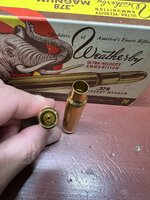
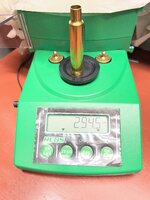
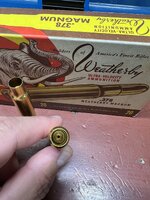
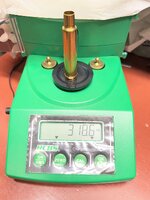
I do know that my Norma stamped brass is heavier than the Wby stamped. Another thing with Wby brass is the age of it. The old brass is by far lighter , it can be tell by the flat bottom. You don’t want to mix any of those in.
Old
IMG_7133.jpegIMG_7135.jpeg
New
IMG_7134.jpegIMG_7136.jpeg
With Alliant powders RL-17 is the best for lot to lot I came across. It never needed to be adjusted.
RL-26 has been good for lot to lot with a slight variant in velocity.
 
Thank you Rick. That is what I am talking about!
295 gr vs 318 gr at 5 bucks a case! I know different lots but WTH? It is so frustrating!
I wish Alpha, Lapua or ADG made the big Weatherby brass.
 
Last edited:
In my 7mm Remington Mag I've never had a major issue with either when it comes to hunting accuracy. I went to the range one day with a mixed lot of Remington, Winchester and Federal cases loaded with the same power charge, same WLRM primers, and same bullets. The mixed lot produced very acceptable hunting groups. My sons Remington 760 in 35 Whelen shoots the same point of aim as the day he first sighted it in and powder and primer lots have changed several times over the years.
 
I’ve never really noticed a difference in brass weight. What I find interesting is my 338 RUM shoots R-P and Federal nickel plated to the same velocity and POI out to 800 yds. The Federal cases are a few grains heavier.
As for powder, RL22 would vary from lot to lot but I resolved that by going to 8 lb jugs.

JD338
 
I sorted my Nosler Premium brass in 280AI. I wish I hadn't. It made me a little unhappy with the money I had spent. I'm good with the hunting load I developed but dang.
 
Last edited:
Okay so interesting experiment. I grabbed a few brass that weighed 313 grains then a few brass that weighed 318 grains. These are Norma Weatherby brass for the 378 Weatherby magnum. I calculated water capacity and everything was between 129.9 to 130.7 I did have one that had 131.7 grains but I think I messed up that one so I threw that one out. I am thinking, based on this, that weight does not have much to do with internal capacity. Maybe just the way the brass was made. One piece might be denser in material and less dense on the other. What are your thoughts on this??

I mean theoretically if I load it five brass with one weight and five brass with the heavier weight and internal capacity being less than one grain, it shouldn't make so much difference in velocity and or accuracy.
 
With 1.8 grains capacity difference on a case that large, I would think lot to lot powder variations would have a bigger impact. Why? Varget, it was a learning experience.
 
With 1.8 grains capacity difference on a case that large, I would think lot to lot powder variations would have a bigger impact. Why? Varget, it was a learning experience.
The actual variance in this test is 0.8 grains. I did throw out that 131.7 that was the only one that was way out of whack with the rest. All the rest were right there.
 
Okay so interesting experiment. I grabbed a few brass that weighed 313 grains then a few brass that weighed 318 grains. These are Norma Weatherby brass for the 378 Weatherby magnum. I calculated water capacity and everything was between 129.9 to 130.7 I did have one that had 131.7 grains but I think I messed up that one so I threw that one out. I am thinking, based on this, that weight does not have much to do with internal capacity. Maybe just the way the brass was made. One piece might be denser in material and less dense on the other. What are your thoughts on this??

I mean theoretically if I load it five brass with one weight and five brass with the heavier weight and internal capacity being less than one grain, it shouldn't make so much difference in velocity and or accuracy.
The case with the bigger variation, you can use it as practice rounds or to foul a barrel after cleaning. With that big of a case, the variations between 129.9 to 130.7 is not much to worry about. Results on paper will determine that. Any large flyers out of a group that I see on paper, I would put that flyer case on the side and mark it to see if it would make a flyer again on the next reload, if it does that again, that it goes in the " practice or foul pile".
 
Im a little OCD with my case weight. While Ive found that there is no difference I like my cases to be within a couple grains of each other. Water capacity is what I would be concerned about the most.

The only time Ive ever had any powder lot issues was with Varget and that only happened once. Unless Im trying a new powder I buy enough powder in lots to do me a while. Probably got enough to do me the rest of my life and then some!

You need to buy powder by the dump truck load to feed that 378!
 
I believe weight sorting brass is usually a waste of time for hunting accuracy.
The actual variance in this test is 0.8 grains. I did throw out that 131.7 that was the only one that was way out of whack with the rest. All the rest were right there.
.8 grains or .06% not the least bit concerned about this tiny amount!
 
Last edited:
watch velocity . when you get one that's out of whack , mark the case . next cycle , if that same case is not with the rest , set it aside . we are trying to get cases to produce the same velocity , weighing , or checking water capacity is one way to " try "and achieve this . the chrony will sort too . you're not really looking at the exact velocity produced , your looking for the outliers . a load that gives a low ES , will really make the odd balls stand out .

if I open a new can of powder , and the velocity is a bunch different , I'll adjust the charge to get velocity back close to normal . I had an 8 pounder of RL33 that was so slow , I couldn't add enough to get the velocity up , I was out of case capacity . to try and avoid that problem again , I would dump a bunch of powder together and blend it well to get an even mix . this seemed to help from getting a jug of fast here , and a jug of slow there . after I started doing the huge mixes , I had little problems with velocity swings . this is especially important if you are only able to get one pound containers of powder , and they are different lot numbers . .

for normal hunting out to a couple hundred yards , you can put together some pretty crappy ammo , and still bring lots of meat home . velocity swings , within reason , does not affect much on the target , at closer distances . this is another reason temp stable powders , don't mean much to the average hunter .
 
As far as powder lot goes, I do try to buy a 5 pounder (or whatever is offered by the manufacturer). If only one pounders are available then I buy a few and if they do have different lot #'s I mix them together in a big canister and make my own blend and adjusting the load.
 
Back
Top