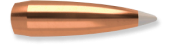
I find a good chronograph to be an essential reloading tool, saying this if I can get a marriage of accuracy and velocity great. In recent years I am transitioning all of my hunting rifles to hammer hunter monolithic bullets for several reasons lower maximum pressure because of reduced surface area on the bullet caused by a series of parabolic band ridges on the bullet. The side benefit of this is increased velocity which seems to mitigate a monolithic bullets reduced g7 BC. While I am no expert on Hammer Hunter monolithic bullets I find them to be substantially easier to find great accuracy compared to cup and core bullets design. By going with this bullet design, it is essential to know the actual barrel twist rate to achieve high bullet stability usually a person has to drop down 10-15% in bullet weight compared to a cup and core bullet design to achieve the desired bullet stability. thus preventing a bullet from key holding on target. My preference is a minimum of 1.7 but prefer a value closer to 2.0 or more. In my 280 Remington I am achieving 3170 fps with a 131 gr hammer bullets with a 5 shot ES of 6 with a sub MOA group. All of this with zero lead to potentially poisoning for birds that will scavenge a gut pile. Sad part is that it takes very little lead to cause lead poisoning to any raptor!
Navigation
Install the app
How to install the app on iOS
Follow along with the video below to see how to install our site as a web app on your home screen.

Note: this_feature_currently_requires_accessing_site_using_safari
More options
You are using an out of date browser. It may not display this or other websites correctly.
You should upgrade or use an alternative browser.
You should upgrade or use an alternative browser.
Velocity and accuracy
- Thread starter Aberhan
- Start date

RiverRider
Handloader
- Dec 9, 2008
- 1,495
- 191
I reload for peak performance from my rifles which means top velocity and the best consistent groups. If I can't obtain both, I moving on to a different combination.
That's just about the same place I've found myself at the conclusion of my quests. I see it as a matter of balancing accuracy with velocity.
If you look for trajectory, then you realize that velocity is your friend, BUT you also find that to obtain significant trajectory advantages, a LOT more velocity is required...and to achieve "a lot" more velocity a HUGE increase in pressure is required. In light of all that, you're best off choosing the most accurate load you can generate---but with a caveat: if you can gain significant velocity by compromising on accuracy just a little, then it might make sense to do so.
As an example, I might be able to get 0.6 MOA for five shots averaging 2675 fps as opposed to 0.8 MOA at 2900 fps. Is 225 fps worth 0.2 MOA of accuracy? The answer is not always so clearcut. For me, a lot of other factors would play into the decision, but in general I see an extra 50 or 75 fps as being meaningless.
I think we get a lot more hung up on numbers than is good for us.
I do not believe there is a direct correlation between reduced velocity and accuracy. A number of competitive sports are pushing things hard. Do not try this at home.
Look at F-TR loads in 223 with 90 grain bullets. These are 30" barrels with .169"+ freebore, 2.5"+ OALs, and scary pressures. 2750fps would be the "low node" and the high node can smoke Lapua brass's primer pockets in 1-3 reloads but will still shoot sub 0.5 MOA. I am not advocating anyone try this, I myself am a chicken. Last time I chrono'd my hot weather load it was running ~2670 fps +/- (from memory).
Edited for clarity
Look at F-TR loads in 223 with 90 grain bullets. These are 30" barrels with .169"+ freebore, 2.5"+ OALs, and scary pressures. 2750fps would be the "low node" and the high node can smoke Lapua brass's primer pockets in 1-3 reloads but will still shoot sub 0.5 MOA. I am not advocating anyone try this, I myself am a chicken. Last time I chrono'd my hot weather load it was running ~2670 fps +/- (from memory).
Edited for clarity
I let the rifle tell me. For instance in my 300 Win Mag hunting rifle I have worked toward loads that match factory velocities, give good accuracy and show no worrisome pressure changes,This results in a load that gives me 3,050fps ,180gr bullet and 1 moa accuracy. In my 308 rifles I can get 2700fps with 180gr Juggernauts in an Accuracy International rifle, no pressure problem, 0.5 MOA accuracy but can't get that velocity with a 165gr bullet in a Steyr SSG. My Tikka 6.5 Creedmoor can't top 2,600fps (140 to 143gr bullets) with any factory load or safe (in my hands) reloads. A Ruger precision rifle I used to own easily made the 2,700fps level easily with the same loads.
"That said, I have a Ruger #1AB in 7x57 that I may need to experiment with."
Not if you're lucky. I have a small collection of Ruger $1a, A's. B's, S, and H models.Most are fair shooters and a few flat out stink. However, there is a group of four rifles, three S and one B that shot sub MOA from the get go with my pet load using the 200 gr. Speer Hot Core. All four are chambered to the .300 Win. Mag.
The load was originally worked up in a Winchester M70 with a 26" barrel. No use giving the load as the powder used was dropped by Winchester more than twenty years ago. I just happen to have a supply which I hoard Jealously.
PJ
Not if you're lucky.
I have a small collection of Ruger $1a, A's. B's, S, and H models.Most are fair shooters and a few flat out stink. However, there is a group of four rifles, three S and one B that shot sub MOA from the get go with my pet load using the 200 gr. Speer Hot Core. All four are chambered to the .300 Win. Mag.The load was originally worked up in a Winchester M70 with a 26" barrel. No use giving the load as the powder used was dropped by Winchester more than twenty years ago. I just happen to have a supply which I hoard Jealously.
PJ
Speed v accuracy, can one have both? Yes, no, maybe. The rifle and the components used are the final arbiters in the equation. Then there are the decsions on what is allowable for a particular cartridge. That's usually decided by SAAMI or the factory that designed the cartridge or even the strength of a particular firearm as determined by someone, probably aligned with SAAMI.
Here are four cartridges that are not loaded to their full potential by the factories.
1.7x57 Mauser
2. .257 Roberts
3.280 Remington
4. .35 Whelen:
andthere may be others I'm not aware of.
Numbers one and two because of some of the early rifle chambered to the rounds. We all know that the 1893,95 and 96 Mausers are considered too weak for modern load pressures. I'm not sure I go along with that but that's me. One gun rarely mention or mentioned in passing are the Remington Rolling blocks made for some of the Latin American countries. Some came with a chamber that wasn't made to the proper specs for the 7x57 cartridge and would blow up the rifle real quick like. Not sure if it was a headspace problem or why the difference.
The 93/95 and 96 Mauser rifles never came chambered to the .257 Roberts but many were rebarreled and made into light sporters back in the day.
so factory and load data were kept at the same mild levels as the 7x57.
The .280 Remington and .35 Whelen are loaded to the same pressure level as the 30-06 at Remington's request. As both can be loaded to a much higher pressure in the same level as the .270 Winchester, why not the .280 and .35?
Simple answer really. Remington wanted to sell them in the pump and semi-auto rifles they make so ignored the fact that they were perfect for the bolt action rifle. Remington finally relented and chambered them in the M700.
I have, and have shot rifles in all four cartridges and it's my not very humble opinion the if the 7x57 and .280 Rem, had been loaded to their full potential, we would have had no need for the 7-08 or .280AI. On the .35 Whelen, what data I could find when it was a wildcat was all over the place. I was given a starting load with RL15 and worked up from there and I run a Barnes 225 gr. TSX at 2700 FPS. Is it a final max load? I don't think so but it may be close. My rifle shots it sub MOA all day long so I'm good following Murphy's second law. "If it ain't broken, don't fixit."
Just my short take on the 93, 95, and96 Mauser rifles The "eggspurts" question their quality and strength. I don't think the Germans sold inferior weapons to the various countries that bought them. That would defeat their purpose; to continue selling guns.The same for the 96 Swedish Mauser. They do have their faults but I also think they may not have been as weak as has been claimed.
Shortly after the end of WW2, there was a flood of all kinds of military rifles and people were making sporting gun out of the, The American gun manufacturers just couldn't keep up with the demand. Soon, ads showe up in magazines like the Rifleman, Out door life and the like says how weak and dangerous those gun were. Their aim was to kill the competition from those old military rifles.
PJ
Here are four cartridges that are not loaded to their full potential by the factories.
1.7x57 Mauser
2. .257 Roberts
3.280 Remington
4. .35 Whelen:
andthere may be others I'm not aware of.
Numbers one and two because of some of the early rifle chambered to the rounds. We all know that the 1893,95 and 96 Mausers are considered too weak for modern load pressures. I'm not sure I go along with that but that's me. One gun rarely mention or mentioned in passing are the Remington Rolling blocks made for some of the Latin American countries. Some came with a chamber that wasn't made to the proper specs for the 7x57 cartridge and would blow up the rifle real quick like. Not sure if it was a headspace problem or why the difference.
The 93/95 and 96 Mauser rifles never came chambered to the .257 Roberts but many were rebarreled and made into light sporters back in the day.
so factory and load data were kept at the same mild levels as the 7x57.
The .280 Remington and .35 Whelen are loaded to the same pressure level as the 30-06 at Remington's request. As both can be loaded to a much higher pressure in the same level as the .270 Winchester, why not the .280 and .35?
Simple answer really. Remington wanted to sell them in the pump and semi-auto rifles they make so ignored the fact that they were perfect for the bolt action rifle. Remington finally relented and chambered them in the M700.
I have, and have shot rifles in all four cartridges and it's my not very humble opinion the if the 7x57 and .280 Rem, had been loaded to their full potential, we would have had no need for the 7-08 or .280AI. On the .35 Whelen, what data I could find when it was a wildcat was all over the place. I was given a starting load with RL15 and worked up from there and I run a Barnes 225 gr. TSX at 2700 FPS. Is it a final max load? I don't think so but it may be close. My rifle shots it sub MOA all day long so I'm good following Murphy's second law. "If it ain't broken, don't fixit."
Just my short take on the 93, 95, and96 Mauser rifles The "eggspurts" question their quality and strength. I don't think the Germans sold inferior weapons to the various countries that bought them. That would defeat their purpose; to continue selling guns.The same for the 96 Swedish Mauser. They do have their faults but I also think they may not have been as weak as has been claimed.
Shortly after the end of WW2, there was a flood of all kinds of military rifles and people were making sporting gun out of the, The American gun manufacturers just couldn't keep up with the demand. Soon, ads showe up in magazines like the Rifleman, Out door life and the like says how weak and dangerous those gun were. Their aim was to kill the competition from those old military rifles.
PJ

RL338
Handloader
- Mar 23, 2017
- 4,915
- 8,622
I’ve found heavy contoured custom barrels are way more forgiving as velocity picks up and accuracy isn’t affected as much as a factory barrel.