Die to press alignment

TackDriver284

Handloader
Feb 13, 2016
2,973
3,219
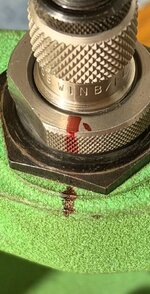
I use Redding full length non bushing and bushing dies along with competition seating dies on a Redding Boss press. I use the trusty Hornady lock rings to secure my dies. I have no issues with accuracy with my rifles, but I have seen some runout of .003" after using the bushing sizing die which is not major runout but just a thought on how to reduce runout. I put an o ring between the die and press, unlocked the lock ring and backed it out about 2-3 turns, and hand tightened the die against the o ring on the press, lubed a case and sized, measuring, and kept screwing in the die until .002" bump was set. Locked the Hornady die ring, marked the location on the press and die so it lines up each time I screw in the die. Checked runout on a .308 15X fired case which was wet tumbled for the first time, and it measures .002" run out which is reasonable on a no turn neck. With the O ring / die, pushing the die front and back gives it a small to and fro movement, compared to without the 0 ring.
Has anyone had any success with the O ring or has it not shown any difference?
 

Attachments

  • oring.JPG
    oring.JPG
    54.4 KB · Views: 5
TD are you saying you’re seeing .003” runout after a case is sized of .003” run out after seating a bullet?

The reason I ask is I had a few sets of dies that would pull the necks crooked when I would extract the case from the sizer die and the neck pulled over the expander.

All I did in those cases was loosen the expander rod a bit so it had some movement so the case could pull straight over the ball, versus the rod being tight and pulling the neck out of wack.

I’d imagine your O-Ring does about the same thing.
 
TD are you saying you’re seeing .003” runout after a case is sized of .003” run out after seating a bullet?

The reason I ask is I had a few sets of dies that would pull the necks crooked when I would extract the case from the sizer die and the neck pulled over the expander.

All I did in those cases was loosen the expander rod a bit so it had some movement so the case could pull straight over the ball, versus the rod being tight and pulling the neck out of wack.

I’d imagine your O-Ring does about the same thing.
Never dealt with this myself, but is there a way to orient the shell holder to allow for self-adjustment of the case as it’s pressed in?
If it’s the expander ball and stem, and they aren’t bent, I’d throw the expander away and use a mandrel and mandrel die.
 
Never dealt with this myself, but is there a way to orient the shell holder to allow for self-adjustment of the case as it’s pressed in?
If it’s the expander ball and stem, and they aren’t bent, I’d throw the expander away and use a mandrel and mandrel die.
No idea. I mostly use a Forster Coax which should help with the problem all the way around. I’ve just gotten into the habit of keeping the decappimg rod a bit lose, not really loose, just enough you can move the decappimg pin around with your finger. Some dies come with a rubber washer just for that reason I believe.
 
No idea. I mostly use a Forster Coax which should help with the problem all the way around. I’ve just gotten into the habit of keeping the decappimg rod a bit lose, not really loose, just enough you can move the decappimg pin around with your finger. Some dies come with a rubber washer just for that reason I believe.
That’s one thing I like about 21st century Mandrels/Dies.
They can self align.
 
TD are you saying you’re seeing .003” runout after a case is sized of .003” run out after seating a bullet?

The reason I ask is I had a few sets of dies that would pull the necks crooked when I would extract the case from the sizer die and the neck pulled over the expander.

All I did in those cases was loosen the expander rod a bit so it had some movement so the case could pull straight over the ball, versus the rod being tight and pulling the neck out of wack.

I’d imagine your O-Ring does about the same thing.
No, sorry for not being clear in the first place, I meant just the sized case neck on a RCBS CaseMaster to check neck runout, without the bullet seated in it. As for the expander, I never liked them for the reason you gave, I removed them all from my dies, I use a Sinclair carbide expanding mandrel as a 2nd step after sizing. I use an expanding mandrel .001" under bullet diameter, like a .307 mandrel for the .308 cases. I keep most of my neck tension to .001" , but I also have .002" mandrels.
 
Last edited:
Never dealt with this myself, but is there a way to orient the shell holder to allow for self-adjustment of the case as it’s pressed in?
If it’s the expander ball and stem, and they aren’t bent, I’d throw the expander away and use a mandrel and mandrel die.
I use the Sinclair expanding mandrels.
 
With the O ring / die, pushing the die front and back gives it a small to and fro movement, compared to without the 0 ring.
This is what Hornady’s LnL bushing press does. You thread your die into a bushing that has an o-ring under the bushing flange and lock it into the press. I’ve been using these for years and wether or not it helps I’m not sure.
 
Die to press alignment is not usually an issue, but die to case alignment is:
Aligning your F/L die to case is not so difficult... loosen the de-cap rod & run a lubed case into the die. Then as you back the case out & feel the case neck enter the loose de-cap expander ball, Hold the press lever in situ with expander in the neck & tighten the de-cap rod. The case is then centralised in the die & case neck/body run out of case neck to case body should likely be no more than .001" Max. Often my case neck/body run out is around .0005". Bullet seating runout is usually less than .002-3" runout. After doing this, any further runout found may well be due to brass thickness variations.
 
Last edited:
No, sorry for not being clear in the first place, I meant just the sized case neck on a RCBS CaseMaster to check neck runout, without the bullet seated in it. As for the expander, I never liked them for the reason you gave, I removed them all from my dies, I use a carbide expanding mandrel as a 2nd step after sizing. I use an expanding mandrel .001" under bullet diameter, like a .307 mandrel for the .308 cases. I keep most of my neck tension to .001" , but I also have .002" mandrels.
are you measuring the .002" runout before or after using the mandrel , to expand the neck ?
 
Haven't used the mandrel to expand it yet, I was testing the runout after sizing.
Mark , great , that's what I hoped for ,you're checking after each step.

if this is a bushing die ; when you shake the die can you hear the bushing move ? the bushing should be free to move . try flipping the bushing over , to see if that helps . how much are you down sizing the neck ? I "THINK" they say to only down size something like .005" max , if more than this use a bigger bushing first , then go to the preferred size .

is the die making firm contact with the shellholder ? I'm not sure if this would matter . I'm thinking the bending would happen before the die reached the shellholder .
 
Mark , great , that's what I hoped for ,you're checking after each step.

if this is a bushing die ; when you shake the die can you hear the bushing move ? the bushing should be free to move . try flipping the bushing over , to see if that helps . how much are you down sizing the neck ? I "THINK" they say to only down size something like .005" max , if more than this use a bigger bushing first , then go to the preferred size .

is the die making firm contact with the shellholder ? I'm not sure if this would matter . I'm thinking the bending would happen before the die reached the shellholder .
Yes, barely can hear it, I backed off the bushing by a quarter turn and the bushing numbers are facing down.
The fired case measures .341 on the neck, and the bushing is a .336, that gives me .005" size down, and its .338 loaded. I could try a .337 bushing if I have one , but the .307 mandrel won't serve any purpose to open the neck.
I'll measure the concentricity of the neck thickness later today with my ball micrometer and see what it shows me.
The die is not touching the shellholder, the .002" bump happens first.
 
You may want to experiment with a mandrel to expand.
Use a Wilson type seat die with a arbor press.

Main thing is what it is doing on the target consistently
Mandrel will be the next step and I'll check run out again, first I'll check the concentricity of the case neck thickness.
 
Back
Top