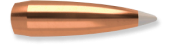
Bergers for Hunting or Not?

I shoot Bergers exclusively in my match rifles. However, I would never consider a bullet with those design criteria for any big game. Maybe groundhogs. My big game rifles have seen Sierra’s, Hornady, and Noslers. I’m glad to see the old solid base boat tails back without the ballistic tips.
 
I have tried the 135gr Classic hunters in my 6.5 creedmoor. Killed 2 deer this year. Doe went 20 yards with a complete pass through and great blood trail. Buck went 50 yards downhill with complete pass through and excellent blood trail. I would try them again.
 
Just ordered another batch of ABLR for my 6.5 Mega.
129grs and they will be on high speed pursuit, maxed out with regular 130AB’s earlier at 3505fps.
 
I have not used them and won't use them on Game Animals. I want a bullet that will expand nicely, retain some weight, and penetrate like it should. When I was in H.S. hunting with my father one year I had a nice buck antelope stop broadside from me at about 50 yards standing broadside. I shot him right behind the shoulder in the lungs. He dropped like lightning had struck him and never moved. I was shooting my 6mm Remington loaded with a 85 gr. Sierra boat-tail hollow-point bullet. I was planning to use it on a coyote when this opportunity presented itself to me. Yes it killed that antelope as quickly as I had ever seen an animal taken before, but.............................. When I dressed him out the bullet went in and disintegrated with not one piece of jacket or lead making it to the inside of the chest cavity on the opposite side of the buck. It worked but certainly not recommended.
Used that bullet Sierra Game King 85 gn HPBT over 49.1gn RL26 in 243Win. Was getting 3250fps. Used it on crop damage deer. 6 shot. 6 recovered. 5 took zero steps. No exit wounds. As you mentioned, no obviously recoverable bullet. The odd deer, had an exit wound. Made it 25 yards and piled up. Fond of that bullet. That said working on a 243 NBT 90 grains and next would be 85 grain NPT.
 
To date, non-Berger user. Working a 168 gr load for 300 WSM work white tail/antelope.
Opposite that will be a 180 NPT.
 
Never used one hunting. Shot a few on paper over the years.

Why does it matter if the tip is cleaned out on a Berger? Doesn’t the nose just collapse on impact? Sorry for the question. I was wondering when a few said make sure the tip is cleaned out. I always thought they initiated expansion from the tip getting smashed and the bullet coming unglued from there.
 
Never used one hunting. Shot a few on paper over the years.

Why does it matter if the tip is cleaned out on a Berger? Doesn’t the nose just collapse on impact? Sorry for the question. I was wondering when a few said make sure the tip is cleaned out. I always thought they initiated expansion from the tip getting smashed and the bullet coming unglued from there.
That’s my impression as well

JD338
 
Correct me if I am wrong, but my understanding of a hollow point bullet was that when penetrating the target, material entered the cavity and the rapid pressure increase of this action initiated expansion of the tip (as opposed to smashing it in), and caused the petals of the tip to tear open and peel back, causing further rapid expansion of the bullet as it continued to penetrate, due to the design of the thin jacket at the tip (physics). Dependant upon the rest of the bullet's design, the jacket design and design of the rest of the bullet determined the extent of the expansion and penetration qualities.
If I think about it a little more, shooting this type of bullet on a steel plate, I can see how one would think that the tips just smashes in, as their is no soft material in the target (such as hair, hide, and muscle tissue) to target to create or initiate the expansion, and tip is actually "smashed".

Before the advent of the various tips (plastic or alloy, e.g., Ballistic Tip, Bronze Point, and A Tip) that are designed to increase BC numbers of a bullet, that are driven back into the bullet upon impact to promote expansion, the main method for improving a bullets tip profile and BC numbers was to design a very fine tip (meplat) with a hollow point cavity, that would still promote expansion. e.g., Sierra Match Kings.

Therefore I can understand why someone would want to check the hollow point on a such a bullet as a Berger, if using for hunting, to ensure that it will expand properly on game.
Although it makes me wonder if Berger is concerned about overall accuracy and high BC numbers (there is no doubt about their high BCs and accuracy potential), that they are neglecting the quality control of their product's other important design feature where one must clean out the hollow point in order to ensure that it will expand properly on game when used for hunting?
(It needs more care than just adding "Hunter" or "Hunting" to the label of their product.)
Not saying that this is the case of Berger's QA/QC, but if their customers must perform this final quality control measure at home, then it makes me wonder if this step is lacking its due diligence at the factory. (This would also require a high level of scrutiny of all those thousands of tiny meplats, that would add to the cost and time of production.)
 
I've never used one of the Bergers in anything and frankly probably never will. Someone mentioned the ABLRs and what little I have done with them has been pretty dismal. I tried the 150 gr. ABLR in three different 7x57 rifles and a .280 Remington. Nothing even close to good in the 7x57s and the closest to a group came from the .280 at roughly 3.5" for three shots. It only did that one time.
Some people have suggested that the current twist rate commonly used in 7x57 rifles today are 1 in 9.5 and 1 in 10". One of my 7x57s has the original 1 in 8.6" twist for the cartridge and it shot no better than the other two rifles. Two of the 7x57s are sub MOA to MOA depending on the bullet use and only the Ruger #1A runs larger groups, usually 1.25 to 1.50" again depending on the bullet used.
The rifle with the proper twist (one in 8.6") Is a clone of a late preWW2 Mauser Sporter with a 23" Douglas barrel. This rifle runs mostly about .75" with just about every bullet I've tried but I've settled on the 150 gr. Nosler Parttion for now. I'm thinking of trying the 150 or 160 gr. AccuBond if my local LGS ever gets any in stock.
Paul B.
 
I've never used one of the Bergers in anything and frankly probably never will. Someone mentioned the ABLRs and what little I have done with them has been pretty dismal. I tried the 150 gr. ABLR in three different 7x57 rifles and a .280 Remington. Nothing even close to good in the 7x57s and the closest to a group came from the .280 at roughly 3.5" for three shots. It only did that one time.
Some people have suggested that the current twist rate commonly used in 7x57 rifles today are 1 in 9.5 and 1 in 10". One of my 7x57s has the original 1 in 8.6" twist for the cartridge and it shot no better than the other two rifles. Two of the 7x57s are sub MOA to MOA depending on the bullet use and only the Ruger #1A runs larger groups, usually 1.25 to 1.50" again depending on the bullet used.
The rifle with the proper twist (one in 8.6") Is a clone of a late preWW2 Mauser Sporter with a 23" Douglas barrel. This rifle runs mostly about .75" with just about every bullet I've tried but I've settled on the 150 gr. Nosler Parttion for now. I'm thinking of trying the 150 or 160 gr. AccuBond if my local LGS ever gets any in stock.
Paul B.
Sorting ABLR’s to the nearest thousandth eliminated flyers for me completely.
Now they are predictable with seating depth changes and have been tight on targets, at the short/medium ranges.
 
a human body is said to be about 60% water . my understanding is , the Berger hollow point gets liquid in it and hydraulically opens the bullet . I'm pretty sure this is how all hollow point bullets work .
 
Back
Top